Plant Reproduction
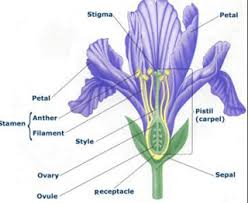
Calyx: It is the outermost whorl of a flower. It comprises units called sepals. In the bud stage, calyx encloses the rest of the flower. They usually exhibit green colouration, at some other instances, they may be a colour like petals. This state of Calyx is termed as petaloid. Calyx can either be prominent or absent.
Corolla: It consists of many numbers of petals and it is the second whorl of the flower. These petals are sometimes fragrant. They are coloured, thin and soft that would help in the process of pollination as they would attract animals and insects.
Reproductive Structure of a Flower
Androecium
It is the male reproductive part of a flower, comprising stamens and it is the third whorl. Each stamen comprises two parts, namely, anther and filament. The tip of the anther is supported by the filament. Here pollens are produced by meiosis and disappear eventually.
Anther: This is a four-lobed sac-like structure responsible for pollen formation.
Filaments: These thread-like structures are attached to the anther, and they keep the anther in place.
The transverse section of an anther is microsporangia that further forms a pollen sac. The pollen sac contains pollen grains.
Microsporangia and Microsporogenesis
Microsporogenesis involves the formation of microspores from microspore mother cells by meiotic division.
The structure of anther: The anther is the breeding part of stamens. Each anther is connected by two lobes. Each anther lobe comprises two pollen chambers located longitudinally. The microsporangium is sufficiently supplied with a number of pollen microspores.
Structure of Microsporangia
Microsporangia consist of:
Tarentum: The cells are multinucleate and this layer is one of the innermost layers of the wall.
Middle layer: It is composed of three to four layers of thin-walled cells. They are located just beneath the endothelium.
Endothecium: This layer is inner to the epidermis. Some cell develops cells of the endothelium.
Epidermis: It is a protective outermost single-layer. Cells of the epidermis in Arceuthobium develop a fibrous thickening and the epidermis is designated as exothecium.
Formation of Pollen grains: The young anther soon becomes four-lobed as it comprises a homogenous mass of parenchymatous cells engirdled by the epidermis. Each archesporial initially present in hypodermal cells divides into the inner primary sporogenous cell and outer primary parietal cell. Each primary sporogenous cell splits to produce microsporocytes. Each microspore mother cell meiotically divides to form pollen grains.
Microgametogenesis (Development of Male Gametophyte): Microspore is partially developed at this stage and it is the first cell of the male gametophyte. The wall of the pollen grain comprises exine (outer layer) and inline (inner layer). The outer layer comprises sporopollenin and the inner layer is made up of pectose and cellulose
Gynoecium
It is the female reproductive organ and the last whorl of the flower. It is composed of pistil and occupies the central position of the thalamus. The stigma, style, and ovary are the components of the pistil. The ovary produces ovules internally. Through meiosis, ovules produce megaspores which in turn develops into female gametophytes. As a result, egg cells are produced.
Gynoecium can be:
Monocarpellary: The gynoecium consists of a single pistil. For eg., peas and beans.
Multicarpellary: Here, gynoecium comprises more than one pistil.
Syncarpous: It is the gynoecium with combined pistil. For eg., Tomato, cucumber.
Apocarpous: It is the gynoecium with free pistil. For eg., Lotus Vinca.
Pistil- Each pistil has three parts:
Ovary: The ovary is a chamber where ovules (eggs) are stored, waiting for fertilization.
Stigma: It is attached to the top of the carpel, where the pollen from other flowers lands.
Style: It is a tubular structure that connects the ovary and the stigma. It is responsible for the transportation of pollen from the stigma to the ovary and holding the stigma in place
 Reproduction in organisms